Anna Swan is only 1/3 of The Thunder of Giants; the rest of the book focuses on Andorra Kelsey, the 8 foot tall woman hired to play Anna in a film. I didn't set out to write a conventional piece of biographical fiction; I was more interested in finding a way to make history and fiction intertwine. Anna Swan lived in that world - many of the facts we have about her, including her magnificent height, are questionable because she lived in a world that dealt with hyperbole and exaggeration. Whenever history and fiction collide, we end up with myth. Myths differ from fairy tales. Fairy tales don't pretend to be real but myths are either based on reality or have some effect on the real world. No one is basing a religion around Cinderella; but the ancient Greeks built temples to Zues. So while Anna Swan is a fascinating figure, I was more interested in exploring her effect on the world decades after her death.
Showing posts with label Fiction. Show all posts
Showing posts with label Fiction. Show all posts
Thursday, August 7, 2014
So...who was Anna Swan?
Anna Swan, born in 1846, stood around 8 feet tall and became a celebrity because of it. She toured Canada, America and Europe, before marrying a man who was also 8 feet tall and settling on a farm in Ohio. She plays a major role in my upcoming novel The Thunder of Giants. But who exactly was she?
Anna Swan is only 1/3 of The Thunder of Giants; the rest of the book focuses on Andorra Kelsey, the 8 foot tall woman hired to play Anna in a film. I didn't set out to write a conventional piece of biographical fiction; I was more interested in finding a way to make history and fiction intertwine. Anna Swan lived in that world - many of the facts we have about her, including her magnificent height, are questionable because she lived in a world that dealt with hyperbole and exaggeration. Whenever history and fiction collide, we end up with myth. Myths differ from fairy tales. Fairy tales don't pretend to be real but myths are either based on reality or have some effect on the real world. No one is basing a religion around Cinderella; but the ancient Greeks built temples to Zues. So while Anna Swan is a fascinating figure, I was more interested in exploring her effect on the world decades after her death.
Anna Swan is only 1/3 of The Thunder of Giants; the rest of the book focuses on Andorra Kelsey, the 8 foot tall woman hired to play Anna in a film. I didn't set out to write a conventional piece of biographical fiction; I was more interested in finding a way to make history and fiction intertwine. Anna Swan lived in that world - many of the facts we have about her, including her magnificent height, are questionable because she lived in a world that dealt with hyperbole and exaggeration. Whenever history and fiction collide, we end up with myth. Myths differ from fairy tales. Fairy tales don't pretend to be real but myths are either based on reality or have some effect on the real world. No one is basing a religion around Cinderella; but the ancient Greeks built temples to Zues. So while Anna Swan is a fascinating figure, I was more interested in exploring her effect on the world decades after her death.


Friday, July 4, 2014
"She Was Probably the Tallest Girl In the World...."
| P.T. Barnum |
And then, on Page 283, everything changed. A single sentence had the same effect as a flat tire on a road trip; it was something which forced me to stop for breath.
Thursday, September 13, 2012
The Accidental Tourist
 by Anne Tyler
Penguin, 355 pages
Some years ago, following a rather bad break-up, I stumbled upon The Accidental Tourist in the dollar bin of a used bookstore. I don't know why I picked it up - I had never read Anne Tyler before and had never seen the movie. But it might have had something to do with these lines from the start of Chapter Two: "After his wife left him, Macon had thought the house would seem larger," writes Tyler. "Instead he felt more crowded. The windows shrank. The ceilings lowered. There was something insistent about the furniture, as if it were pressing in on him."
The story of Macon Leary, the abandoned husband, naturally spoke to me - I too felt I had been abandoned - but before long Tyler's whimiscal plot, charming cast of characters and unintrusive prose meant as much to be as the question of whether Macon Leary would return to the woman who had left him or move forward with the eccentric Muriel Pritchitt.
Sunday, June 10, 2012
An Ode to Robert Harris
8 works of fiction, 5 works of non-fiction
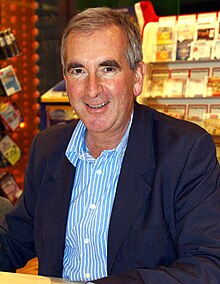
You won't find Robert Harris sitting in that deadly of all sections known as Literary Fiction, at least not in America. If his books show up anywhere, it's either in the category of General Fiction or that risky sub-genre known as "Thriller". You can find him in the airports and pharmacies if not proudly displayed on the bestseller's table at your local book emporium. For this reason, highbrow literary know-it-alls generally refer to him as their guilty pleasure - you won't find The Fear Index at your local book club, where everyone is going gaga over the sequel to Wolf Hall. And you probably won't find some English grad student doing a thesis about the function of metaphor in Fatherland. But this is one highbrow literary know-it-all who's stepping out of the closet. I'm making this plea to book clubs and grad students everywhere: Robert Harris is a pleasure and there's no need to feel any guilt.
Tuesday, April 10, 2012
Grand Hotel by Vicki Baum
 Doubleday Press, 302 pages.
Long out of print (even the reprint is out of print), Vicki Baum's Grand Hotel is mostly forgotten except to librarians, famed only to lovers of old films (two versions were made) and musicals (a Tommy Tune directed version swept Broadway in 1989). The novel itself seems to have been swept from our cultural memory and this is unfortunate: it remains a tightly conceived story of six disparate characters and the way their fates intertwine over the course of two days at the eponymous hotel. Both story and prose (translated by Basil Creighton) survive the ages and in some cases remain surprisingly relevant - most especially in the story of Preysing, the manager of a company, who is faced with the decision of whether or not to succumb to dishonest business practices just to make a buck.
Saturday, February 11, 2012
Out of Oz
by Gregory Maguire

!! This review contains spoilers !!
Although one has to credit Gregory Maguire for his imagination, devotion and skill - his brains, heart and courage, as it were - it would be a tough job to recommend Out of Oz to anyone but the most devoted fans. The book is the final volume of a massive reworking of the Oz mythology dubbed The Wicked Years, a long, complicated saga about war, politics and love that have earned Maguire comparisons to J.R.R. Tolkien, Robert Jordan and other creators of the sprawling fantasia. But Out of Oz, more than any of the three books that came before it, seems to strain under Maguire's literary efforts. Everything is a little too labored, especially the narrative, which is a meandering timeline of events that spans the years but leaves the characters themselves lost in its wake.
Thursday, January 12, 2012
The Suitcase by Sergei Dovlatov
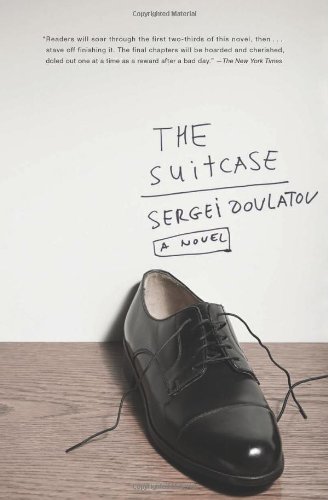
The government of the Soviet Union (1922 - 1991) produced an army of disasters in their day, but no one can ever fault them for giving us Sergei Dovlatov. Born just after the Nazis invaded Mother Russia, Dovltaov would survive the war and go on to be a soldier, prison guard and journalist before escaping to the United States. Anticipating "creative non-fiction" years before the term was ever invented, Dovlatov wrote in a terse, comical style in the voice of a narrator created in his own image. The Suitcase is no exception. A wry collection of short stories about a Russian named Sergei - who was once a prison guard, worked as a journalist and emigrated to the States - The Suitcase merrily blurs the genres to create a work that is entirely unique.
Saturday, November 5, 2011
Saturday by Ian McEwan.

Jonathan Cape, 279 pages.
Ian McEwan has made a career putting the literary in literary fiction, but with Saturday he outdoes even himself. A novel that manages to be both dense and quiet, Saturday takes us slowly - very slowly - through a day in the life neurosurgeon Henry Perowne, allowing Mr. McEwan to revel in the mundane. Even the act of urinating deserves a paragraph of its own, which may be all you need to know in order to decide if Saturday is for you. Make no mistake: this is an exquisite book that reveals both the poetry and the disquiet in he most mundane of things. But Mr. McEwan is in no hurry to get to his point. Like The Comfort of Strangers, a much earlier novel, this is a book which almost imperceptibly pushes its characters towards an unforseen and startling climax.
Saturday, October 29, 2011
The Mark of Zorro by Johnston McCulley
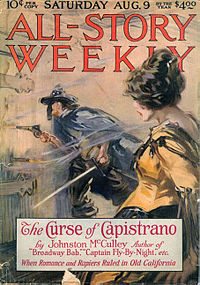 (Audiobook) Read by B.J. Harrison. approx. 8 hours.
Monday, September 26, 2011
State of Fear

by Michael Crichton, Harper Collins. 602 pages.
Is it possible that Michael Crichton, of all people, is this generation's George Bernard Shaw? It's not the most common comparison, but hear me out. Shaw was a social critic whose plays were written to discuss a particular social ill: prostitution (Mrs. Warren's Profession) or the exploitation of the underprivileged (Widower's House). At the same time, he wrote entertainments (he called them "Pleasent Plays"), some of which proved to be his most enduring work (see Pygmalion, the basis for My Fair Lady). Cut to Mr. Crichton who, like Shaw, isn't afraid to put his opinion in a preface or afterword. His canon is also a mixture of popular entertainments (Jurassic Park, The Great Train Robbery) mixed with books which have a more political purpose - abortion (A Case of Need), genetic engineering (Next) and, as is the case with State of Fear, global warming. To Mr. Crichton, global warming is a social ill that needs to be addressed: he is, at best, skeptical of the science behind climate change, a fact which made this book controversial after it's release in 2004 and continues to be touted by those who believe climate change to be a hoax.
Wednesday, September 7, 2011
I Am Mary Dunne

by Brian Moore. Penguin, 187 pages.
All literary affairs - like all love in general, I suppose - happen at different speeds. Sarah Vowell hit me like a ton of bricks, but Brian Moore came up quietly beside me, gently poking me in the ribs each time I walked into a book store. "Remember Brian Moore?" he says. "Remember how much you liked the last book?" And so I buy another of his books and then another. I Am Mary Dunne, written in 1968, is the sixth novel by Mr. Moore that I've read and I'm sorry to say that it's taken this long for me to realize that he and I are definitely having a literary affair. That Mary Dunne has cemented this realization is probably a testament to the book itself, which seems as quiet and unassuming as its title character. The book, like its heroine, is something easily passed by on your way to flashier things. But this would be a mistake, for both are filled with tragedy as heartbreaking as it is quiet.
Monday, August 29, 2011
2030 by Albert Brooks
 St Martin's Press, 375 pages.
It's too bad that the late Michael Crichton never got to write 2030, because in his hands it might have been a great book. Crichton was a genius at marrying an epic cast of characters with complicated exposition, all wrapped into a tense dramatic scenario - look at The Andromeda Strain, Jurassic Park or more recently, Next. Next (reviewed elsewhere) is perhaps the closest ancestor to 2030, as both take on clinical tones to discuss the not-so-distant future. But Next ends up being far more sinister in its implications. In the hands of filmmaker Albert Brooks, 2030 actually comes across as rather benign. Perhaps it's because the author's cinematic instincts are so much more honed then his literary ones: 2030 is dialogue heavy and the narration is short, brief and always to the point. Major events - earthquakes, deaths, China buying Los Angeles - all happen in the blink of an eye without any real attention paid to the drama of the moment. The entire novel reads like a treatment for a film that never got written.
Thursday, August 18, 2011
Various Positions

by Martha Schabas, Doubleday. 361 pages.
Being a former theatre school brat, I couldn't help but be drawn to Various Positions, an affecting first novel by Martha Schabas that deals with adolescence, broken homes and the fact that when you're dealing with the artistic world, the "rules do not apply". This, at least, is the conclusion reached by Georgia Slade, Ms. Schabas' engrossing main character, who is accepted to the Royal Toronto Ballet Academy and promptly begins both an artistic and sexual awakening. A bit of Black Swan meets Fame, Various Positions took me back to my own days in dance school and successfully captured the tense student rivalry and unfortunate eating disorders that are the undercurrent of any artistic training.
Wednesday, July 20, 2011
Father of Frankenstein
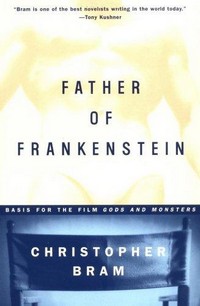
Like author Peter Straub, I read most of this book in one sitting, a true compliment considering how restless one can get on a hot summer day. Reading this book so soon after Doctorow's Homer and Langley, I couldn't help but draw parallels, not because of the subject matter, but because both books create fictional versions of history that are true to the spirit of people involved if not the actual facts. Here, Mr. Baum's focus is the final days of James Whale, best remembered as the director of Frankenstien, who drowned himself in his Hollywood swimming pool in 1957. History is unapologetically subverted as Mr. Baum creates a tryptych of characters that are both wildly comical and deeply profound: Whale himself, his loyal maid Maria and Clayton Boone, an aimless yardman who shares Whale's final days.
Thursday, June 30, 2011
Family Sins
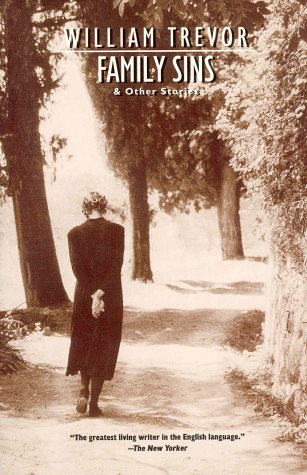
by William Trevor. Key Porter Books, 251 pages.
Any writer who has been declared "the greatest writer in the English language" by an army of prestigious critics - the New Yorker, the London Free Press etc. - demands a closer examination then most. Like Shakespeare, William Trevor might forever be a victim of his own praise: lauded by so many, the expectations for his work can be so high that one risks a book-ful of disappointment. This fear is not realized in the case of Family Sins, a collection of stories published in 1999 which more or less exists as a good testament to what the literarti have long been so excited about.
Tuesday, June 14, 2011
The Year of the Flood

by Margaret Atwood, McLelland and Stewart, 434 pages
The most interesting thing about The Year of the Flood is - sadly - not the book itself but rather the story behind it. The second book in what is presumably a sci-fi trilogy (?) by a Canadian icon known more for highbrow literary fiction, The Year of the Flood is a nice example of an author challenging herself and her readers by offering material that is not easily classified. This has no doubt provided consternation for the people who work at bookstore chains: do you shelf Year of the Flood in "literary fiction"? Or do you put it in science fiction? Who do you market this book to - the highbrow literary folk or readers who like nothing more than to curl up with Issac Asimov? All interesting questions that would make for a much more intriguing book club discussion then any you might have about Year of the Flood, which is an admirable but utlimately messy book that (dare I say it) drowns in the waters of its own ambition.
Friday, June 3, 2011
Homer and Langley

It's always a joy to be reminded why one of your favorite writers is one of your favorite writers. I pretty much whipped through all of E.L. Doctorow's work in a two year period about a decade ago, returning to him only for The March in 2005. Mr. Doctorow is obsessed with history and is always mining it for his inspiration: but with Homer and Langley he gleefully abuses the facts of history to create a work that is at once both historical and mythic. In doing so he has written a heartbreaking and evocative work that has officially become one of my new favorite books.
Monday, May 30, 2011
The Manticore

It's probably blasphemy to be Canadian and attack anything written by Robertson Davies, but I'm going to do it anyway. (I've done it before; back in university, I argued that Tempest-Tost was a great failure of literature). The Manitcore is not a lousy book but it is massively underwhelming, especially given that it won the Governor's General Award back in 1972. Rumor has it this was an apologetic award, as in the Governor General was apologizing for not giving Davies the award for the far superior Fifth Business in 1970. One can only hope the rumor is true; either that or 1972 was a (really) bad year for Canadian fiction.
Friday, May 13, 2011

The Particular Sadness of Lemon Cake
Aimee Bender, Doubleday, 292 Pages
A whimsical coming-of-age story, The Particular Sadness of Lemon Cake attempts to do in novel form what Aimee Bender has almost perfected in her short stories: marry our reality with another as a means of exploring the human tragicomedy. She is mostly successful, although I can't say Lemon Cake has the same sharpness of her shorter works. For all its cleverness and beauty, the novel is not nearly as focused in its narrative scope.
Sunday, May 1, 2011

For Whom the Bell Tolls
by Ernest Hemingway, Scribner, 471 pages
Is there anything that can be sad about this book or its author that has not already been said? One of the classic novels of the modern age, For Whom the Bell Tolls is definitely quintessential Hemingway, one of his last major works (not counting the work published posthumously, it would be followed only by Across the River and Into the Trees and The Old Man and the Sea.) By now, Papa Hemingway had clearly perfected his own inimitable style, that magnificent simplicity that so many have either envied or loathed. And thematically, Papa Hemingway is in his usual territory of large ideas: the fine lines between courage and cowardice, between loyalty and betrayal.
Subscribe to:
Posts (Atom)