Showing posts with label American History. Show all posts

Friday, July 4, 2014

"She Was Probably the Tallest Girl In the World...."

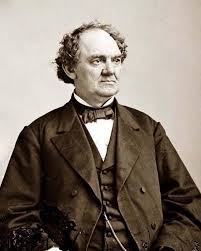
P.T. Barnum
About six years ago I went through a phase where I read all the books that had been turned into musicals. I began with Gregory Maguire's Wicked, went straight through Leroux's The Phantom of the Opera, made a left at Dubose Heyward's Porgy, went a few miles with Hugo's Les Miserables, and finally ended up in the middle of nowhere with a copy of Struggles and Triumphs, the autobiography of 19th century American showman P.T. Barnum. Struggles and Triumphs wasn't the official source material for the Cy Coleman-Michael Stewart musical Barnum, but the no doubt mined it for material. I thought the book might be a bit of a slog but it was surprisingly engaging. Barnum was famous for his various schemes to amaze, astonish and occasionally humbug his audiences with Siamese twins, dwarves, wolfboys, living skeletons and other human curiosities. I settled in for an intriguing portrait of this "first purveyor of mass entertainment" (as the editors at Penguin Classics called him), already planning to move on to E.L. Doctorow's Ragtime when I was done.

And then, on Page 283, everything changed. A single sentence had the same effect as a flat tire on a road trip; it was something which forced me to stop for breath.

Saturday, March 10, 2012

Frank
The Story of Frances Folsom Cleveland, America's Youngest First Lady
by Annette Dunlap
Excelsior Editions, 2009. 195 pages.

More an extended encyclopedia entry then a comprehensive biography, Annette Dunlap's survey of the life of America's youngest first lady sketches the life of an intriguing figure without ever going too far below the surface. Frances "Frank" Cleveland is a barely remembered First Lady, overshadowed by the tragic glamor of Jacqueline Kennedy, the social activism of Eleanor Roosevelt and even the lunacy of Mary Todd Lincoln. But Frank married Cleveland in more ways then one and as his second term was considered a failure best forgotten, so too has Frank beenexiled from thought. Some historians have tried to rehabilitate Cleveland's reputation recently, so its not surprising that Frank would be resurrected as well. Dunlap herself clearly hopes to champion Frank but her polite narrative is far too brief to ever allow the reader a chance to form their own opinion.

Sunday, March 4, 2012

Tension City:
Inside the Presidential Debates, from Kennedy-Nixon to Obama-McCain
by Jim Lehrer
Random House, New York, 2011. pp 209.

Given that Jim Lehrer has had a front row seat to eleven U.S. presidential debates, you wouldn't be wrong to expect more from Tension City, a slim volume that works as an appetizer when it should have been a meal. The metaphor is apt since, like a good croquette, Tension City is easy to digest and possible to finish in a single sitting. As a man who had a worm's eye view of some significant political moments, Lehrer had the opportunity to supply some deft political analysis, both on the art of debating and the evolution of the televised debate from political confrontation to its current form as orchestrated entertainment. Instead, Lehrer seems content to supply anecdotes and only a few juicy facts as he gives us a whirlwind tour across fifty years of debating history.

Sunday, May 29, 2011

Patriotic Fire
by Winston Groom, Vintage Books, 292 Pages

Most of the scholarship on Andrew Jackson concentrates on his political life, so it's a great treat to dive into any book that focuses entirely on a pre-presidential Jackson, specifically his generalship during the War of 1812. For those who, like me, can't ever seem to get enough of Andrew Jackson, this is a great book that fits neatly on the shelf next to such titles as Robert V. Remini's exhaustive biography and Jon Meacham's American Lion (a single volume account of Jackson's White House years).

Thursday, March 31, 2011

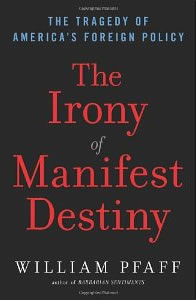
The Irony of Manifest Destiny
by William Pfaff. Walker and Company, 222 pages.

William Pfaff's dissection of American foreign policy is a compact examination that focuses on both the political and religious motivations behind America's involvement in International conflicts. One is tempted to say that it's a timely read, but with America now involved in a pseudo-war with Libya, it feels as if Mr. Pfaff's book will also have some modern relevance. It's unfortunate, then, that Mr. Pfaff's style is not always as succinct as his ideas. Although his ideas are sound, there are times when he becomes so verbose that his thoughts are lost within the density of his own prose.